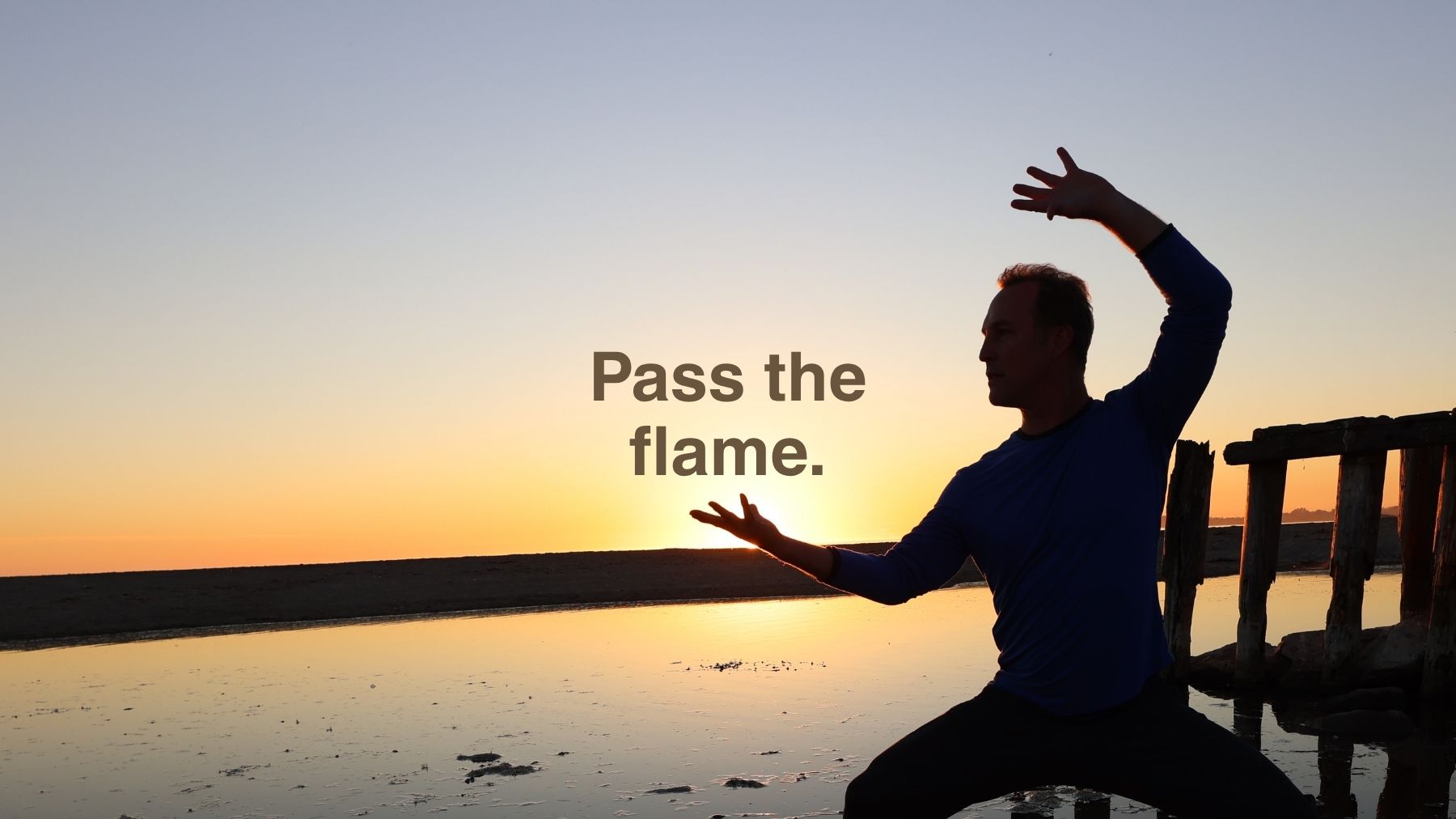
Welcome to Pass the Flame.
The name comes from the way this practice has always traveled.
My teachers lit a candle in me. For thirty-five years I have worked to light it in others, who pass it further along. And the most beautiful part is that a candle loses nothing by lighting another. The flame only spreads. One becomes many, and eventually the whole room fills with light.
That is what this series is about. Over these two weeks I want to show you what it is like to share Qi Gong, to pass that flame, even if you have no intention of ever teaching a class. Because something surprising happens when you learn to think like a teacher, when you say a cue out loud or show a movement with your body. The practice gets deeper. It stops being something you follow and starts becoming something that lives in you.
This began as an email series I am sharing with our community, and I am gathering every lesson here on one page as it goes out, so you can follow the whole arc in one place, return to any lesson, or share it with someone who might need it.
Here is how it works. Each lesson has a quote, a short reflection, and a practice you can do for yourself. From the second lesson on, each one also comes with a small practice you can share with someone else. Move through them as they arrive, or make note of the ones that speak to you. There is no wrong way to use this.
Remember, to know and not to do is not yet to know. So do the practices, don't just read them. The words are only a sliver of the full experience.
Let's begin.
"To know and not to do is not yet to know."
- Wang Yangming
The first time I ever taught a class, I started it hiding in a bathroom stall.
I had just gotten back from a month of teacher training, and a long drive across the country in a van to go study. My mom was running a workshop on yoga and psychology, and she asked me to open each morning with an hour of Qi Gong. It was my first real class. Twenty people showed up, and I was terrified.
I didn't even realize how nervous I was until I was standing in front of them. So I did the only thing I knew how to do. I slipped into the men's room, found an empty stall, started knocking on the door of life, and shook some of the fear loose. Then I walked back out and started teaching, still shaking a little.
Somewhere in the middle of that class, something shifted. I stopped thinking about myself. I realized it wasn't about me at all. It was about giving these people the gift of the practice. The moment I felt that, I relaxed. The whole room started breathing together. And by giving the practice away, I got more back than I ever had practicing alone.
That was the day I actually understood Qi Gong. Not the day I learned the forms, but the day I had to hand them to someone else.
That is what I think of when I read this Wang Yangming quote. To know and not to do is not yet to know. You can practice for years and still hold it at a little distance, as something you follow, something you are fairly sure you understand. It does not fully become yours until it moves through you to someone else, until you have to lead it and it shows you what you actually know.
I have felt this over and over in the years since. When I have to put a movement into words for someone else, I understand it in a way I never did just doing it on my own. I notice where my weight actually is. I feel the breath I had been rushing. Having to say it out loud slows me down and makes me meet the movement, and my own practice is richer for it afterward, not thinner.
And this doesn't only happen in front of a room. Leading can be small. It can be guiding your own body through one movement with real attention instead of going through the motions. It can be showing someone you love how you let your shoulders drop at the end of a long day. The moment you offer the practice, even to yourself, a different kind of attention switches on. You stop consuming it and start listening to it.
That is where following becomes knowing. Not by stacking on more information, but by letting what you already have move through you and out.
Lead one movement, even if just for yourself.
Find a comfortable stance, feet about shoulder width, knees soft, arms resting at your sides.
Instead of following a video, be the guide for a moment. Raise both arms slowly in front of you on an inhale, as if lifting something light out of water, and lower them on the exhale. Cue it in your own words, out loud or silently: rising, and softening, rising, and settling.
Do it a few times, listening to your own voice lead the breath and the movement. Notice anything you did not feel while you were only following along, maybe a little tension in the neck, perhaps a breath you were holding.
Try using it any time your practice starts to feel automatic. Leading even one movement wakes it back up, and often shows you something.
If you want a video to practice with, try this one from my very early days teaching. Maybe you'll even notice where I've shifted as a teacher.
"Knowing others is intelligence
knowing yourself is true wisdom."
- Lao Tzu, Tao Te Ching, Chapter 33 (Stephen Miller translation)
When I guide beginners, I often begin each class by inviting them to notice something simple first. I encourage them to gauge their current stress level on a scale of 1 to 10, or simply to become aware of their shoulders, their breathing, and the general weight of the day they’re carrying. After our practice, I check in again with a similar question: "What's your stress level now?”
I do this because, for years, I have taught people who initially felt nothing was happening. They join me for about 20 minutes, and afterward, they might say they didn't notice much. But when I ask them to rate their stress level at the start, everything changes. They might begin at an 8 and, by the end, drop to a 4. Their eyes light up because they can actually feel the difference. It's a reminder that you can be your own healer. When your mind believes it's possible, your body responds. The proof is right there in your own body if you're willing to notice.
What surprised me when I began teaching this was how checking in and out also sharpened my own practice. When you're aware that you're measuring progress, you become more attentive during the process. This prevents going through the motions because you're motivated to see real change.
Most of us practice based on faith. We hope it's producing results. A teacher learns to frame a session so the student can feel the evidence, and once you do that for yourself, the practice stops being just an idea and becomes something you can sense working, morning after morning.
No special class is needed to learn this; all you need is a moment to compare the before and after.
Today's lesson is based on Module 3 of the certification program, Breath, Stress, and Purging, where we teach people to feel a shift rather than just lean on faith.
Try it on yourself: Before you start practicing, choose one thing to pay attention to and rate it from one to ten. It could be tension in your neck, how you're feeling, or your level of energy. Then, spend three minutes doing some simple breathing or taking one slow, gentle movement. Afterwards, check in again and see if the number has changed.
Try it with another person: Check in on how tense their shoulders feel and ask them to rate it from 1 to 10. Encourage them to take three slow, calming breaths in through the nose, and then exhale slowly through the mouth, making their exhale longer than the inhale. Invite them to rate again. Let them be pleasantly surprised by the difference.
"We are what we think.
All that we are arises with our thoughts.
With our thoughts, we make our world."
- The Dhammapada
I remind my teachers that their main role isn't just to demonstrate movements. It's to guide attention. Think of yourself as the conductor of the room's focused mind, gently directing it from one point to another, and watch as the bodies naturally follow your lead.
My explanation uses a garden hose analogy. Your attention is like a hose, and water is always flowing from it. The only question is where you point it. If you spend the whole day focusing on the weeds, the ache, the worry, or what went wrong, you are watering the weeds, and they grow. Shift that focus to your breath, the warmth building in your palms, or the ease spreading across your shoulders, and those grow instead. Nothing mystical here. Where the mind goes, qi follows.
The first time I really understood this was when I watched what happened when I simply told a room where to look. Put your attention on your hands. Thirty seconds later, hands all over the room are tingling and warm. I did not do anything to their hands. I drew their attention, and the energy followed.
When you learn to guide attention intentionally, two things happen. Your own practice becomes more meaningful, because you stop letting your mind wander into the weeds. And you gain the ability to do for someone else what a skillful teacher did for you, gently guiding their focus and saying, sense and feel right here, right now.
Today's lesson from Module 4 of the Teacher Certification Program focuses on Meridians, TCM, and the Inner Smile, which is essentially a lesson in directing attention.
Try it on yourself: Find one tight or tired place in your body. Bring a soft, warm attention there, like a small smile turned inward, or a patch of sun. Rest it there for three slow breaths. You are watering that area instead of the weeds.
If you want to try it with another person: Ask them to rub their palms together for ten seconds, then hold them an inch apart and focus all their attention on the space between. Ask what they notice. Most people feel warmth or a gentle pull. That is attention transforming into energy, alive, in their own hands.
"When you plant lettuce, if it does not grow well, you don't blame the lettuce."
- Thich Nhat Hanh
I have taught qi gong to five-year-olds, retired Jesuit priests, Silicon Valley engineers eating lunch at their desks, and a room full of women at a Weight Watchers meeting. The same practice, completely different settings. And what I learned is that you never blame the setting. You observe it, and you engage with it.
One year, I taught in Germany, and a few months later, in Brazil. One group wanted precise, step-by-step, clear, and specific instructions: step one, step two, step three. The other group didn’t care about the steps at all; they wanted to feel it and enjoy the flow. Neither approach was right nor wrong. If I had used the same teaching method for both groups, I would have lost them and might have thought something was wrong with them. But the truth is, nothing was wrong. I was just planting lettuce and blaming the lettuce.
At a retired priests' home, everyone was seated, some in wheelchairs, so I abandoned my plan and taught a whole class on breathing. Three men left their canes leaning against the wall and walked out without them. At a global tech company in Silicon Valley, everyone was stuck in their heads, so I slowed everything down and simply asked, "Who here holds tension in their back?" Every hand went up. That was my way in.
Reading a room starts with self-awareness before understanding others. Begin by reflecting on your own mood and then assess your environment. In the Teacher Certification program, I teach how to use the Five Elements as a framework to gauge a person's 'weather.' When you can sense both your own mood and the room's atmosphere, you can select a practice that aligns with these conditions rather than rigidly sticking to your original plan.
Today's lesson is based on Module 8 of the Teacher Certification Program, 'Five Elements Personality and the Tao,' where we explore how to read energy and identify the elements in ourselves and others.
Try it on yourself: Before practicing, identify your current weather mood: wired and buzzy, heavy and slow, foggy, tight and irritable, or flat and low. Then select your activity accordingly. For a wired mood, choose something slow and grounding. If you're feeling flat, opt for an energizing practice. Align your practice with how you actually feel on that day.
If you want to try it with another person: Notice the state of someone near you before you offer anything. Frazzled? Give them one long, slow exhale. Sluggish? A few gentle arm swings to wake the blood up. Read first, then offer.
"The still mind of the sage is the mirror of heaven and earth."
- Zhuangzi
Years ago, a Silicon Valley executive invited me to his home to teach him Qi Gong. He was running a large company and struggled to relax. I’d tell him, 'Let your arms go soft,’ but he’d insist, 'I am relaxed,' even though his arms remained stiff as a robot's. He experienced headaches and heart problems, and kept asking me, 'How do I relax?' I would gently remind him, 'Do less.’
It took him six lessons to comfortably lift and lower his arms. Each time he slowed down, he felt restless and tried to suppress the agitation. However, trying to control his body only made it harder for him. Sometimes, doing less leads to achieving more.
This experience really showed me the importance of embodying calm and presence when guiding others, even in my own practice. I realized you can’t pass on a sense of calm if you're not carrying it yourself. If I had arrived tense and in a rush, nothing I said could have helped him feel at ease. The atmosphere of a room naturally reflects the mood of its leader, not just the instructions given. By consistently calming myself first, I found that his body gradually mirrored that stillness, creating a more peaceful and receptive environment.
Zhuangzi says the quiet mind is like a mirror. When you're calm, the people around you sense it without a word, just like one peaceful person can change the vibe of a whole room. So before you try to lead anything, you need to take care of your own state. That's not just a nice bonus, it's the real work.
Today's lesson is based on Module 10 of the certification, 'Shen, Consciousness and Identity,' emphasizing that the teacher's state is the true form of transmission.
Try it on yourself: Before your first movement, do nothing for three breaths. Let your face soften. Let your hands go heavy. Arrive before you begin. Notice how different the practice feels when you settle first instead of launching in.
If you want to try it with another person: Before you guide someone through anything, take your own slow breath and let your shoulders drop where they can see it. Then lead one slow movement. Watch them mirror your pace without being told. Your calm is the instruction.
"This being human is a guest house. Every morning a new arrival. Welcome and entertain them all."
- Rumi, The Guest House
Sometimes during practice, unexpected reactions emerge, such as a wave of emotion, tears, an uncontrollable yawn, trembling hands, or a sudden flush of heat. New teachers often panic when they notice these signs, fearing they have caused harm or disrupted something.
I teach the opposite. When a student experiences a rise in sensation, I explain that it's not Qi Gong failing them, but rather Qi Gong working effectively. The body has long held onto this, and the practice gives it an outlet. We don't shut the door abruptly; instead, we remain calm, allow the sensation to move freely, and return focus to the breath.
I love sharing a simple yet powerful lesson I often tell my class: get comfortable being uncomfortable. It’s a wonderful Qi Gong lesson that beautifully relates to life too. When you gently accept every wobble instead of seeing it as a problem to fix, it passess through you, leaving you feeling lighter and more at peace.
Rumi describes a person as a guest house, where a fresh visitor arrives each morning, sometimes with sorrow, and sometimes happiness, while he graciously welcomes them all. This perspective captures the spirit of a caring teacher, and it’s a wonderful gift we can offer ourselves. Often, we tense up against our difficult feelings, but practicing openness offers a different way. It’s about holding space, continuing to breathe, and allowing these guests, our feelings, to come and go naturally.
You don't have to fix anyone, including yourself. You just have to stay calm and welcome the visitor.
Today's lesson builds on Module 6 of the certification, Healing Sounds and Principles of Practice, where holding space is presented as a tangible skill rather than a personality attribute.
Try it on yourself: Next time something arises during practice, like a yawn, a wave of emotion, restlessness, or a bit of heat, let it be there. Tell yourself, that's it working. Keep breathing. Watch it move through and pass.
If you want to try it with another person: If someone you're guiding sighs, tears up, or gets fidgety, don’t rush to fix it. Soften your voice, tell them it's normal and even good, and gently help them return to their breath. Your steadiness gives them permission.
"When you are content to be simply yourself,
and don't compare or compete,
everyone will respect you."
- Lao Tzu, Tao Te Ching, Chapter 8
(Stephen Mitchel Translation)
When I work with teachers, there's a special moment I look forward to; it's when they begin to find their own voice instead of trying to sound just like me.
In the beginning, everyone imitates. They copy my phrasing, my pacing, even my jokes. That's fine; it's how you start. But I tell them straight: if you try to be anybody else, you'll always be second best to that person. You can only ever be first at being you. So the real work is finding your own voice.
I talk about it as the difference between following a recipe and being a chef. A recipe follower knows a few steps and can only make those exact dishes. A chef understands the ingredients, the process, the structure, the flow, and the elements deeply enough to cook something fresh for whoever is actually sitting at the table. I would rather become a better energy chef than just collect more recipes. That’s when teaching becomes meaningful, and honestly, that’s when it gets fun.
Here is the part that matters, even if you never teach anyone. When you describe a movement in your own words or images, something clicks into place. It stops being just a video you're copying and becomes something you understand from within. Your body finally owns it. And this brings a wonderful freedom, one I had to learn the hard way. Whatever someone thinks about how you do it is none of your business. You’re not performing; you’re sharing something in your own voice.
Today's lesson builds on the certification's Teaching Fundamentals, where the main goal is discovering your own voice.
Try it on yourself: Pick one movement you know well. Describe it out loud in your own words and images. not mine. Maybe your arms rise like a tide, steam off tea, or a bird lifting. Move as you narrate. Notice how it feels deeper when the words are yours.
If you want to try it with another person: Teach that movement to someone using only your own words, no borrowed script. See how naturally it flows once you stop reciting and start describing what you genuinely feel.
"The sage does not accumulate.
The more he does for others, the more he has;
the more he gives to others, the more he possesses."
(Dwight Goddard Translation)
Years ago, a man named David found himself lying in a hospital bed. The doctors had gently told him to prepare for what was ahead, estimating about four months. Feeling very low, he was flipping through the channels and happened to land on my PBS show, where I was demonstrating Qi Gong on a wooden plank over a stream. Though he couldn't get up, he watched and moved his arms in the air as best he could, following along. In that moment, something inside him whispered, "This is it.”
He ordered the DVDs and watched them every day, gradually improving each time. Weeks went by. He stood up and completed the entire practice. When four months passed, then five, then six, his doctors ran tests and found him in remission. He attended one of my early teacher trainings and shared that story, and everyone in the room was moved to tears.
And here's the part I’ll never forget: David couldn’t stop sharing it. I watched him do Qi Gong with the waitress, with the man at the grocery store. Hey, you want to feel some qi? He was like a candle that had been lit, and he lit everyone he passed.
That is how this practice has endured for thousands of years, not just through books, but through the heartfelt sharing from person to person. Each of my teachers ignited a spark in me, and over the past thirty-five years, I’ve had the privilege of lighting that same spark in others. When you pass on this light, it doesn’t diminish; instead, it brightens the whole room. Truly understanding Qi Gong comes alive when you're part of sharing it. That’s when it stops being just an activity and becomes a way of living.
Today's lesson draws on Module 16 of the certification, the Alchemy of the Three Treasures, where everything you've practiced comes together and expands outward.
Try it on yourself: Combine three movements you enjoy into a brief, personalized practice lasting around three minutes, with a clear start, middle, and an end.
If you want to try it with another person: Guide someone you care about through it from start to finish. Begin with a friendly check-in and end with a warm check-out, just like we practiced in Lesson 2. Pay attention to their face when they notice the change. That moment, the one you helped create, is truly the heart of the experience.
Everything in this series is a taste of what lives inside the Holden QiGong Teacher Certification Program, the complete path from practicing Qi Gong to living it and passing it on. This is the first full revamp of the program in over ten years, and enrollment is $500 off through August 4.
Inside, you get:
Whether you dream of teaching classes one day or simply want this practice to become the way you move through your life, this is where it goes next.
Enroll in the Teacher Certification Program, $500 off through August 4.



.jpg)